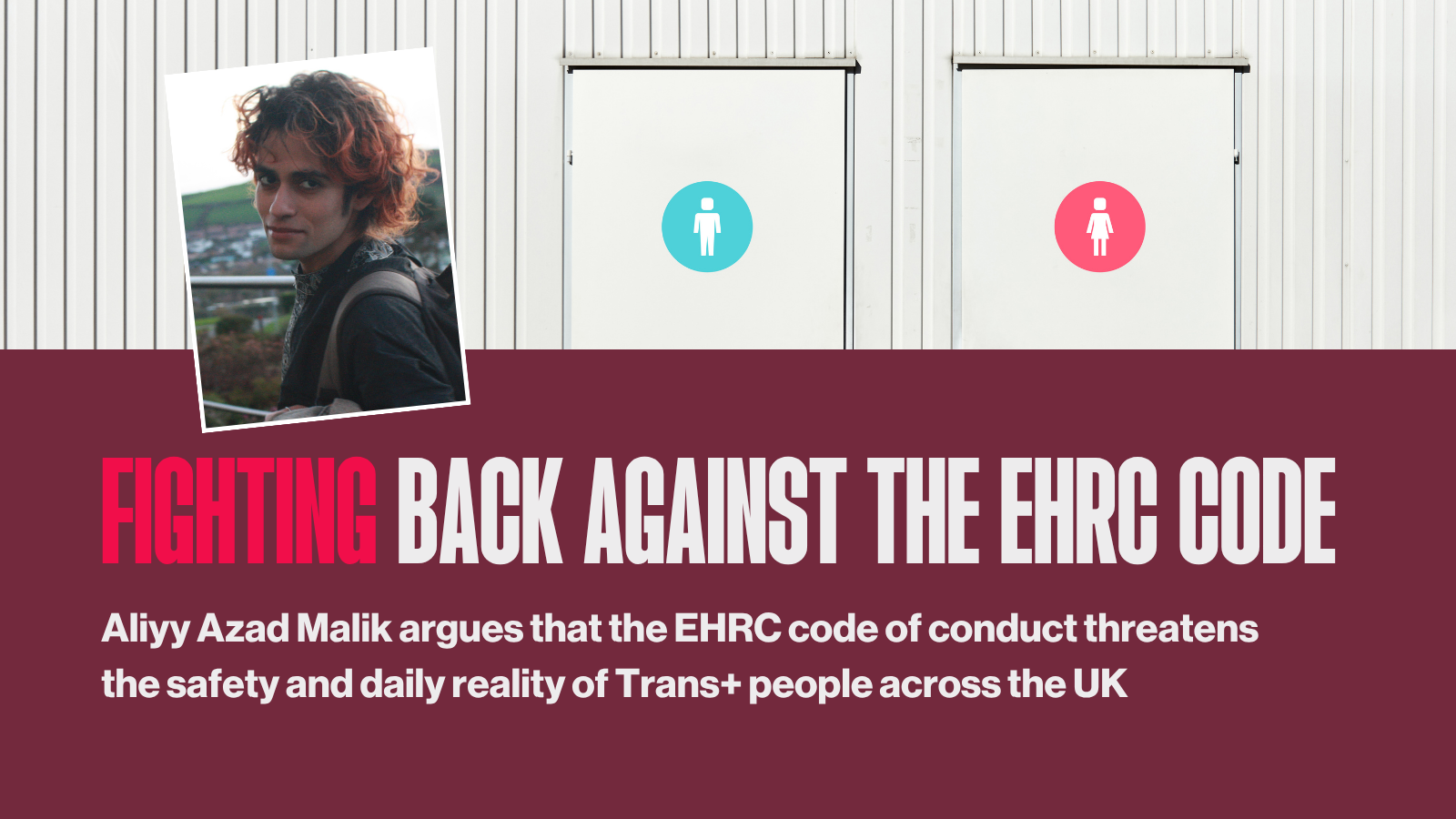
The EHRC code of conduct threatens the safety and daily reality of Trans+ people across the UK. As the pendulum of our decade swings towards more fundamentalist definitions of gender and sex, Trans+ folk still need to negotiate the same world as everyone else. We need toilets, changing rooms, and showers. We need safety, consistency, and access. The effects of the new code’s restrictions to accessing social spaces are about to play out in real time.
How Trans+ people are navigating the code as it begins to slide into practice will begin to lay the groundwork for how we can resist the changes and uphold demands for our human rights.
At my local gym, which I should be going to a lot more regularly, I carry my weights awkwardly across the floor, hunching over and hiding myself. All the effort it takes to lift my arms with even a 8kg weight is peanuts compared to that initial, air-conditioned chill of self-awareness flooding my muscles when I walk in.
The sharpness and clarity of the gym are harshly refined, the lights bright, and the sounds are abrasive. I feel every indentation of my pedal through thick Nike trainers on the exercise bike as though my feet are bare. The clink of bars slotting onto hooks across the room impacts me like it is right next to my ear.
Through research, I now know that this is clinically referred to as hypervigilance. The amygdala, our brain’s threat detector, activates in my daily life and misinterprets normal noise as threat or danger. What it experience in the gym is a flooding of my sympathetic nervous system which traps my body in a constant trigger response. Scientists have studied this overactivity and found it can have direct causality to PTSD or CPTSD. In other words, trauma can cause someone’s brain to experience constant threat in their surroundings. Additionally, studies show that LGBT people already live at a higher risk of PTSD compared with their cisgender/heterosexual peers.
The psychological weight of my body in my gym crushes me when I slip into the bathroom. I cover my face with my hand, holding my beard like I can pause it from growing. My brain and my body have altered themselves to the threat I feel in these spaces. They rush me through my private rituals only to draw out my resulting stress later, once I believe I’m safe.
"Despite my own personal experiences of long-term stress as a result of public harassment I, as well as all other Trans+ people in the UK, will need to keep working and living our lives as our access to architectures of need are hollowed out. "
Writer
The EHRC Code does not promise an end to this reality of public services. Despite my own personal experiences of long-term stress as a result of public harassment I, as well as all other Trans+ people in the UK, will need to keep working and living our lives as our access to architectures of need are hollowed out.
In an interview with a friend living and working in Cardiff, I talked to him about his experience of losing access to toilets in his offices as a result of the EHRC Code. While the Code went through it’s Parliamentary process, his employer slipped the protocol into their model immediately.
He told me that “On Tuesday 26th May they implemented a full Trans bathroom ban in all their offices, giving internal equity groups just an hour’s notice […] They left their staff without any further details for a whole week […] One of the offices they rent out currently has no gender neutral bathrooms, and their main office building has three gender neutral toilets for a building 11 stories high.”Some Trans+ employees refused to come to work. He’s written to his MP, and Trans+ colleagues have stayed in contact – but they remain unclear on what this means for them in the coming weeks and months.
Trans+ people carry the responsibility of keeping watch on organisations and businesses that implement the regulations. I am aware that I will have to rearrange my life around the changing physical spaces I use as well as the psychological landscape of being Trans+ in public. The comprehensive, confident work of people who hold the line at these private, unseen doorways are touchstones to continue living my life, going to the gym, stopping at the toilet.
Trans+ organisations have begun collating resources on what we can or can’t do in public spaces currently,. TransActual’s resource clarifies that under the Equality Act 2020 Trans+ people are ‘still protected from discrimination on the ground of ‘gender reassignment’, regardless of whether you have a GRC or not.’
It also lays out, crucially, that ‘services will still have to be sure not to put trans people (whether they have a GRC or not) at an unjustifiable disadvantage as a result of the segregation.’ If they do, a trans person (with the ‘gender reassignment’ protected characteristic) may be able to claim unlawful discrimination, especially if someone is left without access to any service because none are available or because the trans person feels uncomfortable using their “biological sex” service.’
As we enter this period of uncertainty, knowing our rights – and what we can do to challenge this code, which continues to be called “unworkable” by a growing number of MPs will be critical as we continue fighting to keep ourselves safe.
This article is part of a QueerAF and Inclusive Journalism Cymru partnership dedicated to uplifting Welsh LGBTQIA+ emerging and marginalised journalists.
You can follow Aliyy on Instagram.
Sign up to QueerAF’s weekly newsletter or become a member.


