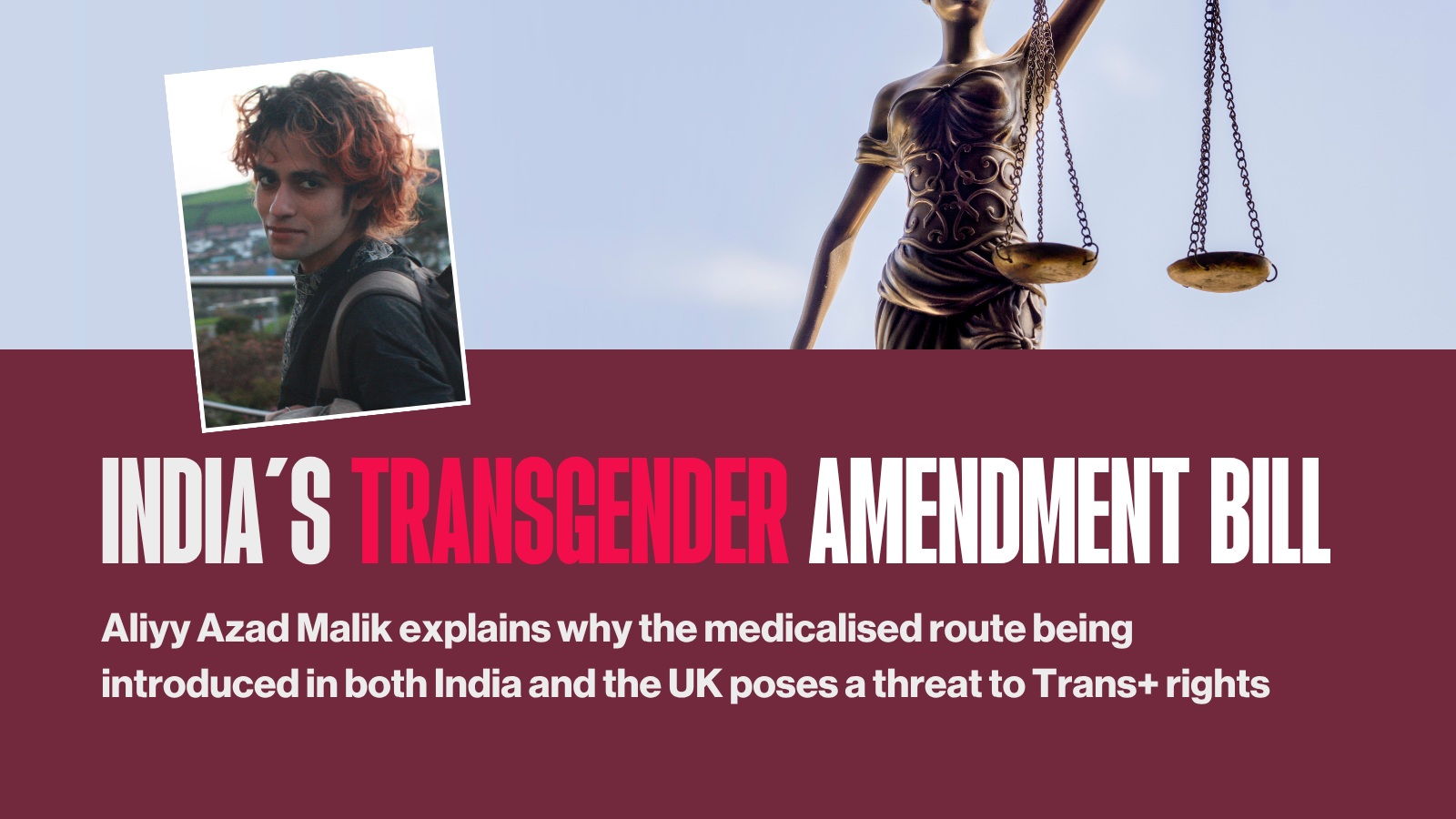
When India passed the 2026 Transgender Persons (Protection of Rights) Amendment Bill nationwide protests erupted against the changes that will devastate the fundamental rights of transgender people in the country. As one of the most populated countries in the world, it is a bill that changes the rights of 1 in 5 Trans+ people in the world.
Protesters have demanded that the amendment be revoked, accusing the legislators of acting with “undue and unjustifiable haste” in passing the bill and calling for consultations with transgender and gender diverse communities.
The bill is an amendment to Transgender Persons (Protection of Rights Act), 2019. One of the most crucial and devastating changes is to narrow the definition of who a transgender person is and will require a medical transition to take place in order to receive legal gender recognition.
Historically integrated Trans+ groups such as hijra and kinner, as well as intersex persons, will still be legally recognised, but anyone who self-identifies as a trans man, trans woman, or non-binary person is no longer included in the category of a legally recognised transgender person, unless they go through a medicalised process.
As a trans person, it is obvious to me that the right to self-identify without approval from a doctor is a crucial aspect of what it means to be Trans+ and, for most of us, this self-identification occurs before medical intervention (if we choose to pursue that). Social transitioning is often not enough, and those Trans+ people who need more are stuck in long wait lists with no other way to further their transition. And yet, even as we wait for treatment on someone else’s timeline, that first moment of defiance and expression is our power. Self-identification is our autonomy.
This power of self-identification is a scarf in the wind, a moment of unauthorised, nonmedicalised determination away from the proscription of gender. When the scarf blows, anyone can see it, it offers that freedom to the world. In her writing, Indian academic ‘VQueer’ Aditya Sahai, said ‘this is the difference between the amendment and its critique, state and the people — one sees trans as population that needs to be controlled, an identity, the other understands it as possibility. The fight is not for the rights of some people who identify as trans but for trans to be a possibility.’
"As a trans person, it is obvious to me that the right to self-identify without approval from a doctor is a crucial aspect of what it means to be Trans+ and, for most of us, this self-identification occurs before medical intervention (if we choose to pursue that)."
Writer
When transgender becomes a category in legislation, that power shifts away from the Trans+ community and to the lawmakers who write the definitive, singular definition for all of us. As often happens, and in this case too, this is done without our consultation, consent, or representation.
I partly left India to transition in the relative safety and peace of the UK.
As I began the medical process here, I was advised by my friends to contort my story to increase my likelihood of fitting the antiquated profile the UK system requires in order for me to get a ‘diagnosis’ of gender dysphoria, which is what opens up support for gender affirming care.
My friend sent me a template of their ‘trans story’ that I could use. Toy cars, gym clothes, wrestling with brothers. Another friend told me he was sick of lying about himself and committed to telling the truth to doctors. I didn’t quite know which option made sense to me.
Throughout my journey through this medicalised process, I paused at many moments to consider what would get me healthcare and what felt true to who I am. I delicately rode the balance of truth and exaggeration. In reflection, the real and more substantive reason I returned to the UK to transition was to be within my established trans community. Not for our broken medical system, whose historical bias and decades of malpractice have been thoroughly reported on.
The medicalised route being introduced in India and the UK is designed to control and limit what being Trans+ looks like. The fear of giving us rights, autonomy, and self-definition comes from the patriarchal system that knows if Trans+ people can challenge the gender binary, anyone can. In other words, this bill reflects that their fear of us is stronger than their fear for us.
This article is part of a QueerAF and Inclusive Journalism Cymru partnership dedicated to uplifting Welsh LGBTQIA+ emerging and marginalised journalists.
You can follow Aliyy on Instagram.
Sign up to QueerAF’s weekly newsletter or become a member.


