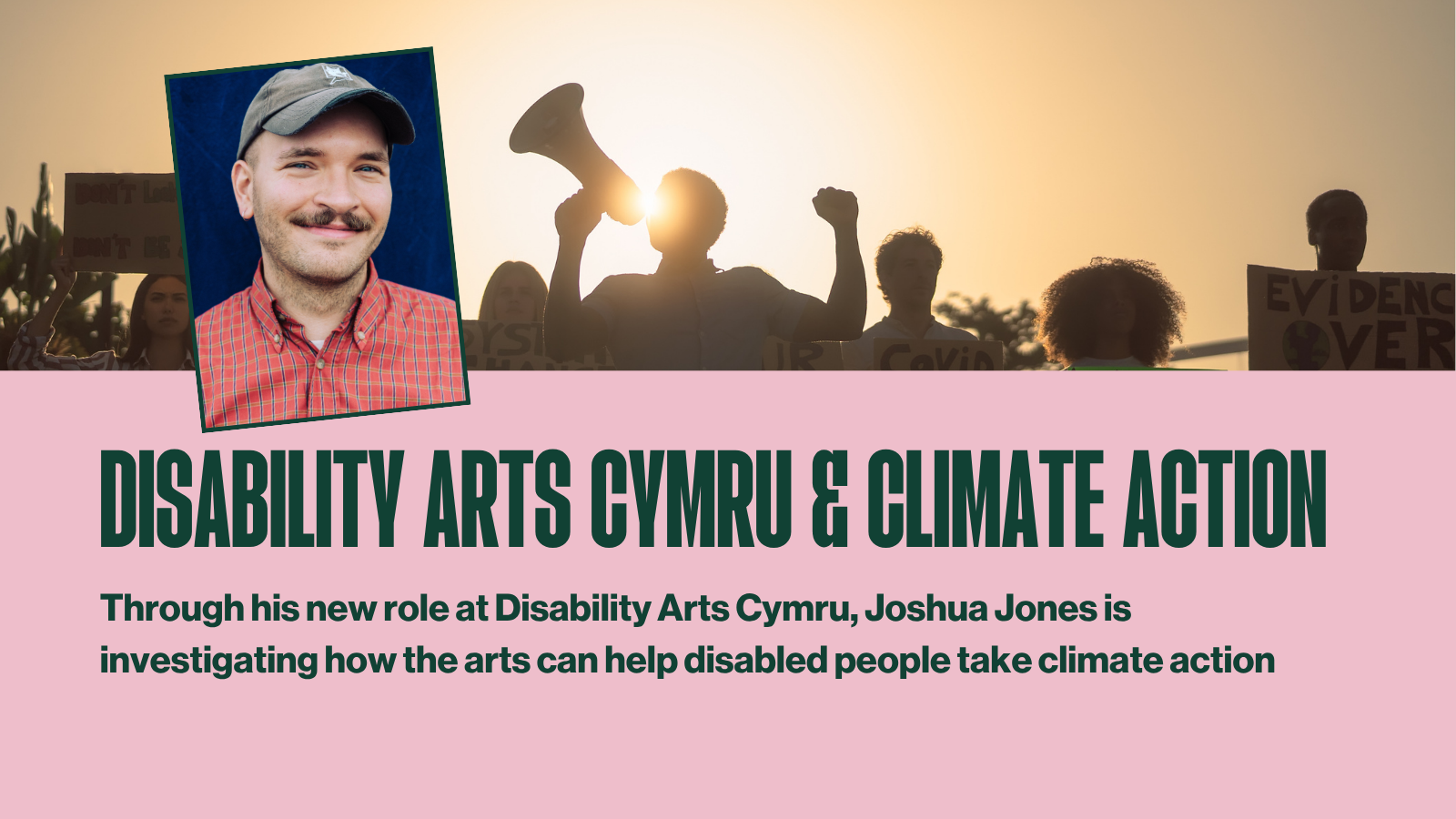
It is a well-known fact that climate change disproportionately affects disabled people. From medications affecting internal temperature regulations, to extreme weather events straining already-stretched public and social infrastructure and the stress heatwaves put on the body and underlying health conditions, d/Disabled people are left feeling vulnerable, overlooked and isolated.
In my role leading the Egin Project for Disability Arts Cymru (DAC), I’m concerned with how d/Disabled people can be better supported in their communities. There are incredible charities in Wales (such as Disability Cymru) who are fighting for the rights of disabled people in governmental policy, or work with specific groups, such as Our Visual World & Sight Life who support d/Deaf and blind/visually impaired people in Wales respectively. DAC’s primary focus is on developing d/Disabled and d/Deaf creative talent, helping our community of disabled artists to produce and share their art. At the heart of what we do, we believe that disability arts should be given equal recognition within the industry, and d/Disabled artists should have barrier-free access to opportunities.
What all these organisations have in common is promoting the adoption and implementation of the Social Model of Disability, of which Disability Arts Cymru was one of the first to adapt and implement. The Social Model of Disability was developed by d/Disabled people, and identifies that it is environmental, organisational, and attitudinal barriers that d/Disabled people and prevent their full participation in society, not their medical conditions, impairments or differences. These barriers include the building of public and social infrastructure that doesn’t consider disabled people’s needs, or society’s internalised ableism. Additionally, these organisations are increasingly concerned about and focusing on the climate crisis.
As a d/Disabled artist in Wales myself, I’m invested in an equitable, caring future for marginalised communities in Wales. I also understand how multiple marginalised identities can coalesce and how this can cause added pressure. With this in mind, I’m in the process of developing a toolkit with the aims of supporting d/Disabled artists in Wales to access climate action. One of my guiding questions has been: what does that actually look like?
"As a d/Disabled artist in Wales myself, I’m invested in an equitable, caring future for marginalised communities in Wales. I also understand how multiple marginalised identities can coalesce and how this can cause added pressure. With this in mind, I’m in the process of developing a toolkit with the aims of supporting d/Disabled artists in Wales to access climate action."
Writer
I’ve been organising in-person information sessions with d/Disabled artists and creatives to discuss the barriers we face to accessing climate action. It’s still early days, but the general consensus is that most d/Disabled people are engaged in and concerned with the ongoing climate crisis and how it affects them. We have talked about the sharing of resources and community assets; repair cafes, ‘libraries of things’ and libraries in general. We spoke at length about how miners’ and workingmen’s institutes were socially radical, in that they were educational and communal centres, with libraries and reading rooms, evening classes as well as entertainment halls and games tables. We have also spoken about “grief spaces”: physical spaces that disabled people can access and be safe within to express grief and concern over the ongoing climate crisis and receive support from each other.
As an addition to the in-person sessions, I’m conducting a survey (linked here and at the bottom of the page) with the hope of getting as many opinions from d/Disabled artists and creatives in Wales on their experiences of accessing climate action as possible, and what can be done by arts organisations in Wales to support them. I believe this is to be a crucial area of research; when social and third spaces are increasingly inaccessible due to underfunding or closure, perhaps we need to look at art spaces as the new community hubs and welfare halls. Many of them are already doing incredible work, and hopefully this research will ultimately benefit as many people as possible.
My colleagues at Disability Arts Cymru have also organised a series of events on climate justice across November and December. Starting with ‘Art as Resistance: Women, Creativity and Challenging Gender Disparities in Healthcare’ with renowned d/Disabled creatives including author and disability rights activist Bethany Handley, and also Delyth Jewell MS (Deputy Minister for Social Care, Mental Health and Women’s Health). Following on, there are events on access to transport, travel and nature, and how we creatively respond to climate change. The series of events culminates with a talk by Professor David Turner, author of Disability: A History of Resistance, at Chapter Arts Centre, Cardiff on International Day of Disabled People, December 3rd. All events are free, open to all and on Zoom, except the final event at Chapter Arts Centre — click here to see all events on the ‘Hwb’ section of DAC’s website.
These conversations around disability access and climate justice are ongoing, but we are all working together towards making sure disabled people in Wales feel less vulnerable, overlooked and isolated, and actively empowered to feel hopeful and heard.
Please take five minutes of your time to fill out the survey on accessing climate action. It can be filled out in Cymraeg or English, by text, audio or video.
Joshua Jones (he/him) is a neurodivergent, disabled writer and artist from Llanelli, South Wales. You can follow him on Substack.


