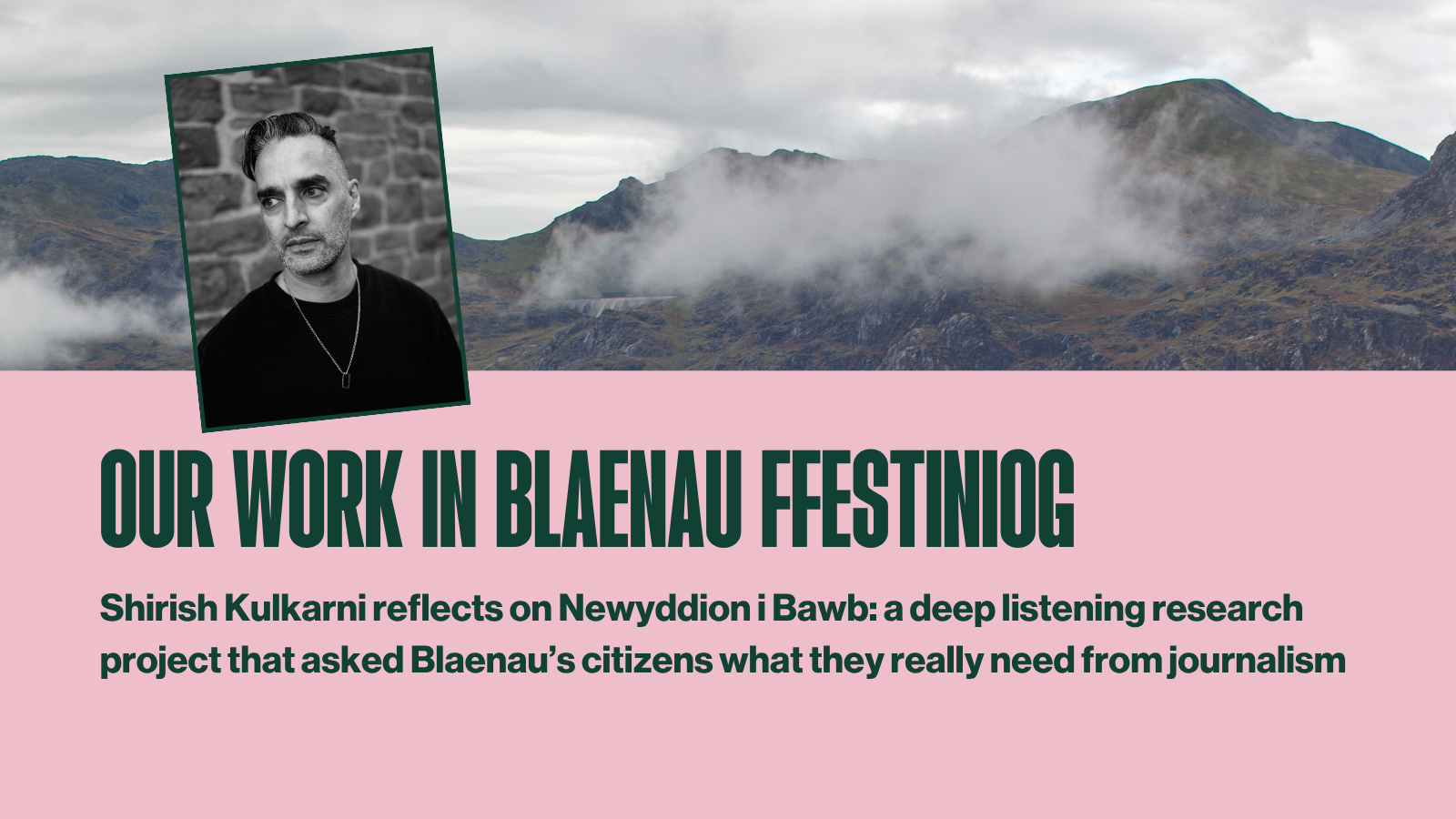
Inclusive Journalism Cymru exists to protect, support and represent people who’ve been marginalised or excluded by the journalism industry. A lot of the time that means journalists – people like us who’ve been kept out of newsrooms, or made to feel we don’t belong once we’re inside. So you might reasonably ask why we’ve spent the past year working with a community in Blaenau Ffestiniog, a former slate-mining town in Eryri.
The answer of course is that exclusion cuts both ways. Journalism decides who gets to tell stories, and it also decides whose stories get told and how. When we started, our partners in Blaenau told us the town felt left behind and detached from power. Plenty of our members would recognise that feeling.
This week we published what we found in Newyddion i Bawb (News for All), as a case study, policy paper and podcast. Although it might not look like it at first sight, this project goes to the heart of what IJC is for.
"I founded IJC after more than 25 years in the industry, much of it spent fighting systemic discrimination, so that the journalists coming after me wouldn’t have to fight the same battles. Working in Blaenau reminded me how similar those battles look, whether you’re on the outside of a newsroom or on the outside of the story."
Writer
Rebuilding trust
Shifting narratives and rebuilding trust is one of our three core aims, and it’s where we focused a lot of our work. Trust in mainstream news was low among the people we worked with, as it is amongst many communities across Wales and beyond. One participant summed it up as “all about the bias, and who to believe.”
We’re very clear – that lack of trust is rational and justified. Part of the problem is how places like Blaenau get covered. As another participant put it, “Blaenau has lots of good projects but rarely gets credit for it.” When a town only appears in the news as a story of decline, people stop recognising themselves in it, and stop trusting whoever is telling it.
So in Blaenau, as we did with News for All in Grangetown, we began with what was right with the place, rather than what was wrong with it.
In this case, that was building on the history of innovation and knowledge sharing symbolised by the caban sessions of the slate mines and the many social enterprises already woven into the fabric of the town.
Changing how the industry listens
We’ve always argued that inclusion can’t stop at who gets hired. Institutions also have to change how they listen. Throughout Newyddion i Bawb, S4C took part as co-researchers on exactly the same footing as everyone else in the room, learning alongside the community rather than studying it. Our policy paper takes that a step further, and asks the Welsh Government to fund community-led work and judge it by whether it brings people together, rather than by how much content it produces.
Supporting journalists, and widening the circle
Supporting marginalised journalists remains central to what we do, and we used the project to connect different strands of our work. Sofia Lewis, IJC’s Cynefin Fellow at the Reuters Institute for the Study of Journalism, joined one of the research weekends, linking what she learnt in Blaenau with her research on class in journalism.
The project also stretched the definition of who counts as a journalist. The group designed and ran their own community events, and while some participants arrived as organisers, storytellers and sense-makers for their own town, many more left that way. If journalism is about helping people understand their world so that they can take action on behalf of their communities (as we believe it is) then this was journalism.
Who we are shaped how we worked
None of this would have worked without the right people in the room. IJC director Silvia Rose led the project locally and co-facilitated some of the sessions with Rhiannon White of Common/Wealth. Silvia is from Eryri herself and a Welsh speaker, and she knows from her own life the challenges facing communities like Blaenau.
“I came to this project bringing my knowledge of the Welsh journalism industry and commitment to inclusion. I came as a local – who lives just over the mountain from Blaenau, who spent years working in Cellb, the arts venue where the research took place, and has a deep understanding of the place and its people. I also came as a writer, leading creative explorations and encouraging participants to connect with underlying beliefs.
These different perspectives allowed me to connect with the issues that arose on both a micro and macro level. I understood and shared the frustrations of feeling left behind in national conversations, the nuance and emotion that the Welsh language carries, and the unique character and vibrancy that exist in our towns and valleys – whose stories could be a great source of inspiration for others if only they were told. And I could see how these issues connect to a wider media landscape of neglect – where so many of our communities are either represented negatively or not represented at all.”
I founded IJC after more than 25 years in the industry, much of it spent fighting systemic discrimination, so that the journalists coming after me wouldn’t have to fight the same battles. Working in Blaenau reminded me how similar those battles look, whether you’re on the outside of a newsroom or on the outside of the story.
Still listening
When we set up IJC, we said we didn’t have all the answers, and that we’d keep listening, learning and growing. This project was all about that. It reminded us that our work has to reach beyond newsrooms, into the places and communities journalism too often overlooks. It also showed us how much more we can do when we work alongside others.
We’ve built lasting partnerships along the way, with organisations including Creative Wales, S4C, Common/Wealth and PDR and made (and renewed) many friendships in Blaenau.
The work is shaping policy too, through our evidence to the Senedd’s Culture Committee and the debate on Wales’s new Shadow Broadcasting and Communications Authority. It’s already travelled well beyond Wales, with coverage across the UK, US and Europe, showing the influence we can have by working deeply and collaboratively.
If you want to know more, the case study, policy paper and podcast are all out now. If this work speaks to you, whether you’re a journalist, a community group or an organisation that’s listening too, do get in touch. We’d love to hear from you.
You can visit Shirish’s website or follow him on LinkedIn or Instagram.


