I don’t buy newspapers. Neither do any of my friends. But that doesn’t mean we’re not interested in what’s happening in the world. We just find out about it differently.
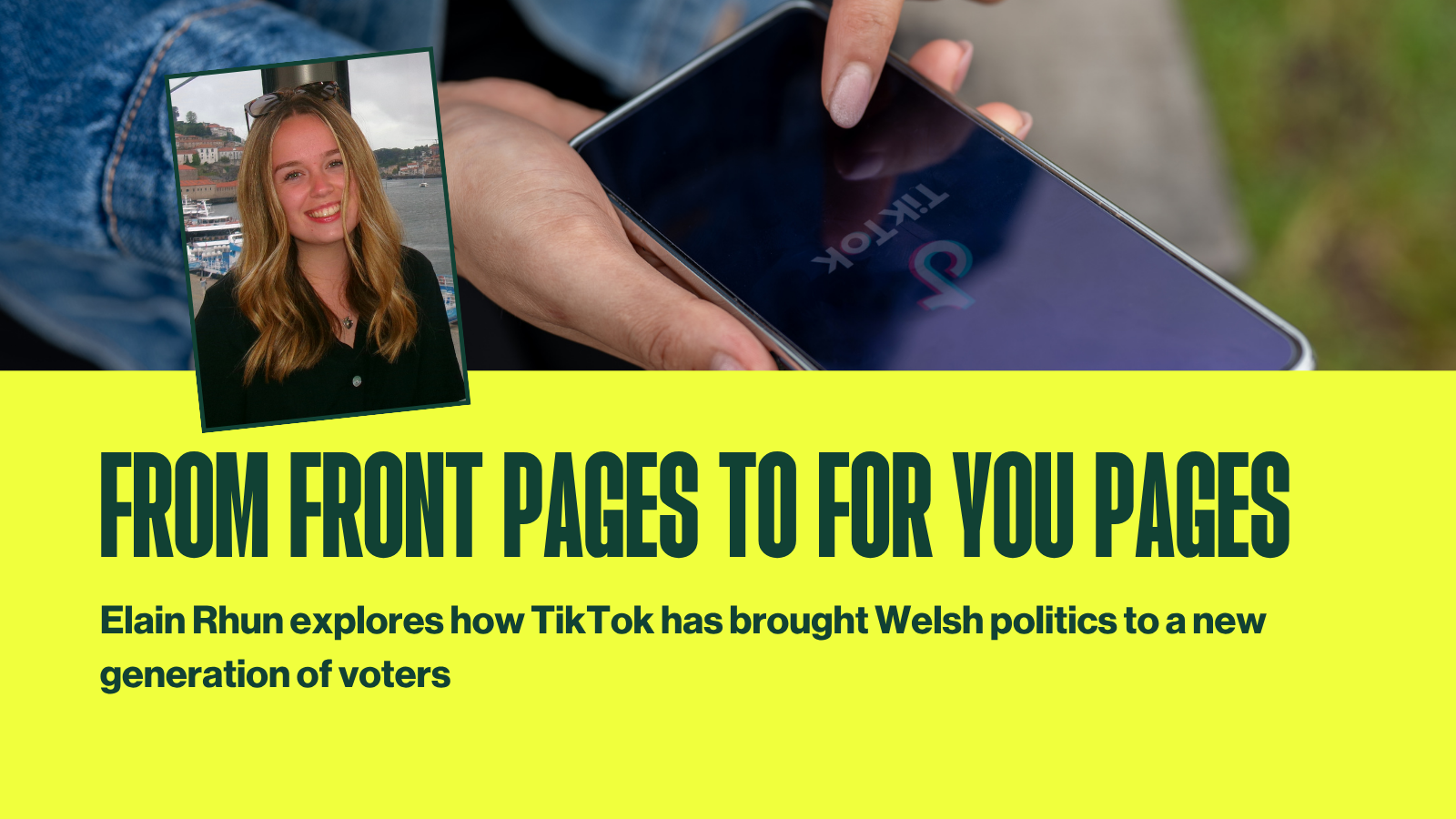
For us, news doesn’t arrive through the letterbox or on a TV at six o’clock. It turns up between a dance trend and a video of someone’s dog, usually when we weren’t even looking for it. There’s no front page, no editor deciding what matters most. Instead, the news we see is shaped by TikTok’s algorithm, which decides what appears on our For You Page and what catches our attention.
Most of the time, I don’t think about it. But in the run-up to the election, I couldn’t ignore it, because suddenly my For You Page was full of Plaid Cymru.
It wasn’t manifestos or interviews. It was edits. Clips of Rhun ap Iorwerth’s voice, “We will defend what others seek to dismantle, cenedl heb iaith, cenedl heb galon. We will never let Reform rip the heart out of our nation,” laid over footage from the Eisteddfod, choirs, Welsh flags and landscapes. The speech became a sound, and the sound became a trend. I watched it many times, sent it to a friend, saved it, reposted it.
Then I realised who was making them. It was one of the first elections where 16 and 17-year-olds could vote, and they were the ones creating and reposting these videos. For them, this was Plaid Cymru’s campaign. Not a leaflet through the door or a debate on the telly. A sound on their phones.
I suddenly found myself taking a real interest in the election, even going as far as looking up the manifestos. But more than anything, I remember how it made me feel. I felt proud, and a little emotional, seeing our small country being talked about and shared across the world on such a huge platform.
As a young person, I know that I probably wouldn’t sit down and read an entire election manifesto or leaflet. It’s not necessarily that young people don’t care about politics, but that we don’t always engage with it in the ways politicians expect us to. TikTok changed that. Short videos highlighting some of Plaid Cymru’s key policies caught my attention in a way a lengthy manifesto probably never would have. Instead of having to seek out political information, it appeared in front of me, in a format I was already used to watching. So when TikTok put Welsh culture, language and politics in the online space where I actually spend my time, it worked.
"As a young person, I know that I probably wouldn’t sit down and read an entire election manifesto or leaflet. It’s not necessarily that young people don’t care about politics, but that we don’t always engage with it in the ways politicians expect us to. TikTok changed that."
Writer
But the honest answer to “What did I learn?” is that I felt a lot and understood very little. Those videos were persuasive because they were emotional, not because they explained anything. A well-edited clip can make a belief feel like an identity, and it’s much harder to argue with an identity than with a policy. I also had to ask why my feed looked the way it did. Was Plaid content everywhere, or had I spent months watching Welsh-language and Welsh culture videos? Did anyone get the same treatment for other parties? An algorithm doesn’t show you the election. It shows you your version of it.
As a postgraduate student, I know how to check sources. Even so, I often learn about stories on social media before I go looking anywhere else. It isn’t replacing journalism for me. It’s the front door to it. The problem is that nobody’s standing there to show me in.
In my opinion, this is what made TikTok so effective during the election. For the first time, 16 and 17-year-olds in Wales could vote in a Senedd election, and political content was appearing on a platform many of us were already using every day. We weren’t necessarily going to sit down and watch long political debates or read pages of manifestos, but a funny meme or a short clip of a politician explaining a policy? That was something we would stop scrolling for.
Credit where it’s due: Plaid Cymru’s social media team understood that. By turning political messages into short, relatable and often funny videos, they made their policies accessible to an audience who might otherwise have scrolled straight past them. It didn’t take a long conversation in the Senedd to get our attention. Sometimes, it took thirty seconds on a For You Page.
That doesn’t mean TikTok should replace traditional journalism or that a short video can tell us everything we need to know about a political party. We still need to question what we see, look beyond the memes and understand the policies behind them. But getting young people interested in the first place is a crucial step.
Inclusive journalism isn’t just about whose stories get told. It’s about making sure those stories reach people, too. And if the next generation of voters is scrolling TikTok, perhaps that’s exactly where journalism needs to meet us.
Elain Rhun is originally from Anglesey and is currently based in Cardiff studying for a postgraduate degree in Neuroscience. You can follow her on Instagram.


